Sarah Schwefel: Patient Activist Joins GCRC Research Team
We're pleased to announce that patient and activist Sarah Schwefel of Las Vegas has became a Research Analyst on the Global Cannabinoid Medicine Research Center Team. Sarah brings to the table quite...
 Mike Robinson
3 min read
We're pleased to announce that patient and activist Sarah Schwefel of Las Vegas has became a Research Analyst on the Global Cannabinoid Medicine Research Center Team. Sarah brings to the table quite a bit of knowledge on various health issues and cannabinoid medicine but most of all her own journey with Elhers Donlos Syndrome and the various effects of the debilitating disease. Like her new Research Leader, she's a warrior and ready to take on the world by offering the awesome new AMA approved 12 CME course we have available on our website through the American Journal of Endocannabinoid Medicine University to healthcare professionals and others wishing to learn, extensively, Endocannabinoid Medicine.
Sarah has a history of being a Terpene Consultant for Toke Tonic, a contributing writer to Bound to Glisten, and has just started 'The Chronic Couple' podcast. She fights daily against the effects of Ehlers-Danlos syndrome which is a group of disorders that affect connective tissues supporting the skin, bones, blood vessels, and many other organs and tissues. Defects in connective tissues cause the signs and symptoms of these conditions, which range from mildly loose joints to life-threatening complications.
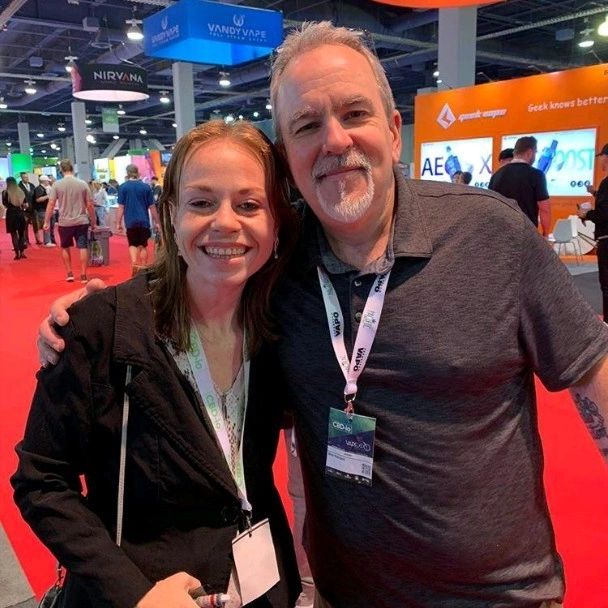
She's seen in the cover photo with me at the CBD io and Vape International Expo in November 2019. As a speaker at the event addressing patients is important as a researcher, it's exciting to see Sarah already doing this and now from her role at the Research Center.
The various forms of Ehlers-Danlos syndrome have been classified in several different ways. Originally, 11 forms of Ehlers-Danlos syndrome were named using Roman numerals to indicate the types (type I, type II, and so on). In 1997, researchers proposed a simpler classification (the Villefranche nomenclature) that reduced the number of types to six and gave them descriptive names based on their major features. In 2017, the classification was updated to include rare forms of Ehlers-Danlos syndrome that were identified more recently. The 2017 classification describes 13 types of Ehlers-Danlos syndrome.
An unusually large range of joint movement (hypermobility) occurs in most forms of Ehlers-Danlos syndrome, and it is a hallmark feature of the hypermobile type. Infants and children with hypermobility often have weak muscle tone (hypotonia), which can delay the development of motor skills such as sitting, standing, and walking. The loose joints are unstable and prone to dislocation and chronic pain. In the arthrochalasia type of Ehlers-Danlos syndrome, infants have hypermobility and dislocations of both hips at birth.
Look forward to the GCRC digging deep into multiple areas of her syndrome to find various approaches in treating others. Many times when there's a complicated situation such as Sarah has, when answers are found it will apply to a wide array of patients.
"I'm excited to get started on the test, I believe all doctors and other people in medicine will benefit greatly from taking the AMA approved course on the research center website. I just started the first module of it and am so absorbed by this and what I know in only one night I can't wait for tomorrow to read and study more!" She stated about the AJEM University 12 C.M.E. AMA course and certified test now on the Global Cannabinoid Research Centers website. "There's millions that want to learn what they didn't get to in college, I even do!" It's time for the next wave of cannabinoid medicine which means we need advanced knowledge not just in the industry – but by healthcare workers as well.
Thank you for applauding as we welcome Sarah to our team!
Mike Robinson, Founder, Global Cannabinoid Research Center
Santa Barbara, California
This article is educational commentary from GCRC. It is not a report of study findings and is not medical advice. Speak with a qualified healthcare professional about your own health.