Just Patented By Prof. Mechoulam: Fatty Acid Amides For Addiction
He's at it again with his discoveries, the godfather of Cannabis Professor Raphael Mechoulam has been issued a patent entitled "Fatty Acid Amides and uses thereof in the treatment of Addiction...
 Mike Robinson
9 min read
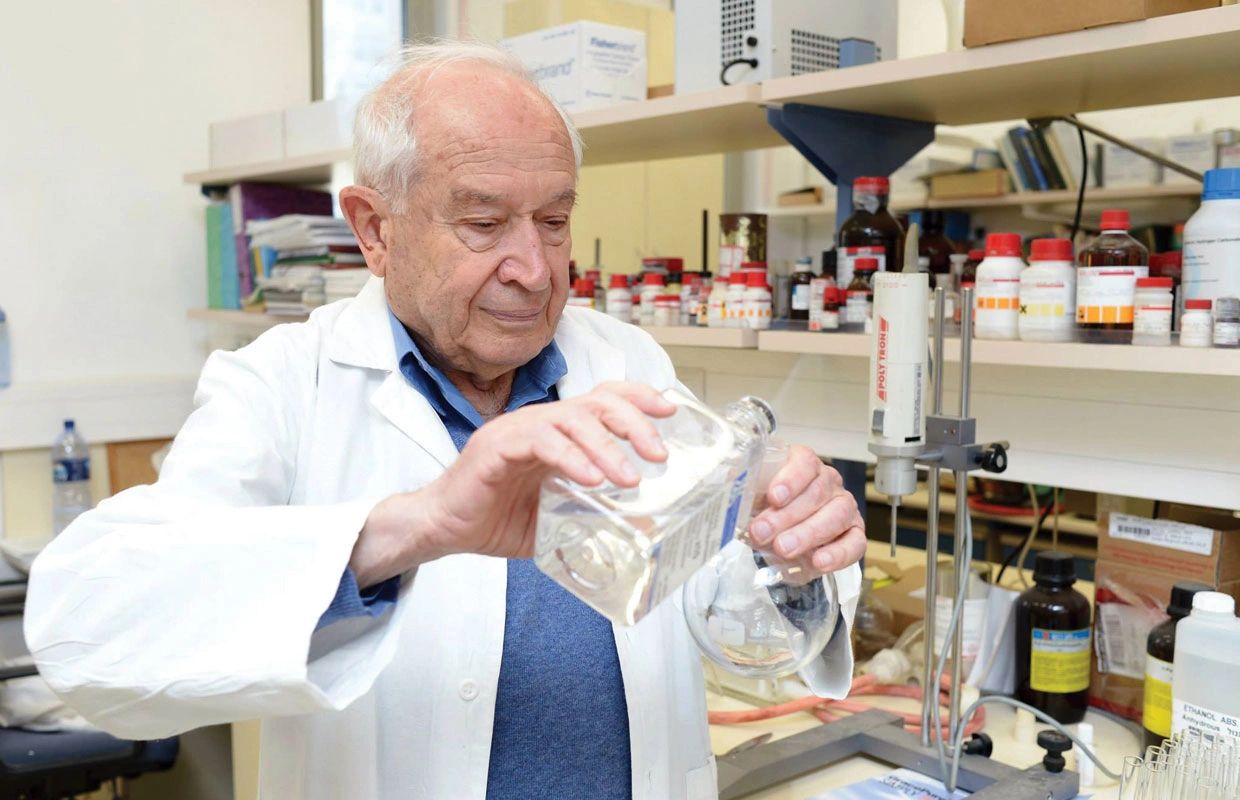
He's at it again with his discoveries, the godfather of Cannabis Professor Raphael Mechoulam has been issued a patent entitled "Fatty Acid Amides and uses thereof in the treatment of Addiction Disorder and addiction related conditions". The man with the plan that discovered how to isolate THC along with two colleagues back in 1964 when the active constituents of cannabis were mostly unknown has utilized extensive knowledge of the Endocannabinod (ECS) system in this invention.
He's targeting and utilizing the ECS, which he also discovered much of including one endocannabinoid called “Anandamide,” It's named for the Sanskrit word describing “supreme joy.” Mechoulam stated decades ago that “We believed then and still do that the endocannabinoid system plays a role in the formation of emotions.” In 1982, Mechoulam said that if cannabis were legal, it would replace ten to twenty percent of all pharmaceuticals.
“I have spent the better part of my life decoding the mysteries that lie within this incredible plant,” Mechoulam said at a CannMed conference. “The collective work on the plant has now led to the identification of a major physiological system, the endocannabinoid system, which seems to be involved in many human diseases.”
His current patented process goes after that same concept he identified so long ago. Attacking addiction and the related conditions isn't simple. Without a doubt I could call myself an authority on this from doing so myself with cannabinoid replacement therapy and helping countless others to beat their dependencies – but nothing that has ever crossed my mind is comparable to the legendary Mechoulam and his brilliance.
You can view the entire patent here: http://www.freepatentsonline.com/20200108037.pdf
CA3064068 – FATTY ACID AMIDES AND USES THEREOF IN THE TREATMENT OF ADDICTION DISORDER AND ADDICTION RELATED CONDITIONS
ABSTRACT:
The present invention is directed to a fatty acid amide of an amino acid, including a stereoisomer and a salt thereof for use in the treatment of a patient suffering from any type of addiction disorder, substance abuse disorder, including any condition and symptom associated therewith and including withdrawal syndrome and relapse addiction during and after a rehabilitation treatment of said patient.
Inventors:Mechoulam, Raphael (Jerusalem, IL)
Di Marzo, Vincenzo (Napoli, IT)
Piscitelli, Fabiana (Mondragone(CE), IT)
Lichtman, Aron H. (Henrico, VA, US)
Damaj, Imad M. (North Chesterfield, VA, US)
Parker, Linda (Campbell River, CA)
Yaka, Rami (Kfar Uria, IL)
Application Number:16/613213Publication Date:04/09/2020Filing Date:05/22/2018View Patent Images:Download PDF 20200108037 PDF helpExport Citation:Click for automatic bibliography generationAssignee:Yissum Research Development Company of The Hebrew University of Jerusalem Ltd. (Jerusalem, IL)
VIRGINIA COMMONWEALTH UNIVERSITY (Richmond, VA, US)
UNIVERSITY OF GUELPH (Guelph, CA)
International Classes:A61K31/20; A61P25/32; A61P25/34; A61P25/36Attorney, Agent or Firm:Pearl Cohen Zedek Latzer Baratz LLP (1500 Broadway 12th Floor, New York, NY, 10036, US)
Claims:1. 1.-42. (canceled)
43. A method of treating at least one of addiction disorder, abuse disorder, withdrawal syndrome during a rehabilitation or detoxification from abusive substance addiction treatment, relapse addiction during or after rehabilitation or detoxification from abusive substance addiction treatment, including any condition and symptom associated therewith in a patient suffering therefrom, said method comprising administering to said patient a fatty acid amide of an amino acid, including a stereoisomer and a salt thereof.
44. The method of claim 43, wherein said fatty acid moiety is selected from a saturated fatty acid moiety, a mono-unsaturated fatty acid moiety and a poly unsaturated fatty acid moiety.
45. The method of claim 43, wherein said amino acid is selected from glycine, dimethylglycine, alanine, serine, cysteine, tyrosine and phenylalanine.
46. The method of claim 43, wherein said amino acid is substituted by at least one group selected from straight or branched —C1-C6 alkyl, straight or branched —C2-C6 alkenyl, straight or branched —C2-C6 alkynyl, —OH, and —O(C1-C10 alkyl).
47. The method of claim 43, wherein said amino acid is substituted by at least one straight or branched —C1-C6 alkyl.
48. The method of claim 43, wherein said fatty acid moiety is substituted by at least one group selected from —C1-C6 alkyl, —OH, —O(C1-C10 alkyl), —SH and —S(C1-C10 alkyl).
49. The method of claim 43, wherein said fatty acid moiety is substituted by at least one —C1-C6 alkyl.
50. The method of claim 43, wherein said fatty acid amide of an amino acid is a compound of general formula (I), including a stereoisomer and a salt thereof: wherein R1 is selected from straight or branched —C13-C22 alkyl, straight or branched —C13-C22 alkenyl and straight or branched —C13-C22 alkynyl; optionally substituted by at least one group selected from straight or branched —C1-C6 alkyl, —OH, —O(C1-C10 alkyl), —SH and —S(C1-C10 alkyl); R2 and R3 are independently selected from H, straight or branched —C1-C6 alkyl, straight or branched —C2-C6 alkenyl, straight or branched —C2-C6 alkynyl; each optionally substituted by at least one —OH, —SH, —O(C1-C6 alkyl), phenyl and phenol; provided that at least one of R2 and R3 is different than H.
51. A method of claim 43, wherein said addiction is drug addiction, cigarette addiction, alcohol addiction, food addiction, behavioral addiction and any combinations thereof.
52. A method of claim 43, wherein said addiction is selected from nicotine addiction, opioid addiction, drug addiction, pain killer drug addiction, cocaine addiction, behavioral addiction and any combinations thereof.
53. A method of claim 43, wherein said substance is a drug, a cigarette, alcoholic beverage, food and any combinations thereof.
54. A method of claim 43, wherein said substance is selected from nicotine, opioid, cocaine, alcohol, food, pain killer drug and any combination thereof.
Description:
BACKGROUND OF THE INVENTION
Cigarette smokers having traumatic brain injury (TBI)-induced damage to the insular cortex display showed cessation of nicotine addiction (Naqvi et al, 2007; Naqvi et al. 2014). Donvito et al. subjected anesthesized mice to the weight drop model of TBI and harvested the insular cortex, hippocampus and hypothalamus 24 hr later. Using targeted lipoomics techniques, they showed profound increases in OlGly in the insular cortex, but not in the hippocampus or hypothalamus of brain damaged mice, not in sham mice. OlGly itself produced neither a place preference nor a place aversion, but it interfered with both a nicotine-induced place preference and reduced precipitated withdrawal responses and a withdrawal induced place aversion in nicotine-dependent mice.
Another drug abuse disorder with considerable cost to society and the individual is opiate addiction. Of the 21.5 million Americans 12 or older that had a substance use disorder in 2014, 1.9 million had a substance use disorder involving prescription pain relievers and 586,000 had a substance use disorder involving heroin (National Institute on Drug Abuse 2015). Withdrawal from opiates is a driving force in the maintenance of opiate addiction (eg, Koob, 2009a,b). Morphine withdrawal (MWD) can be produced by terminating chronic exposure to morphine or by administering an opiate antagonist to morphine pretreated animals. Even after a single exposure to a high dose of morphine, administration of naloxone several hours later produces withdrawal symptoms in humans (Heishman et al, 1990; June et al, 1995) and other animals (Eisenberg, 1982; Martin and Eades, 1964). The withdrawal is apparent not only by behavioral symptoms of abstinence, but also by the ability of such withdrawal to serve as an aversive motivational stimulus. Parker et al. (Parker & Joshi, 1998; Parker et al., 2002) demonstrated that the aversive properties of naloxone precipitated MWD were evident up to 48 hr. after a single injection of morphine, but not saline, in a conditioned place aversion (CPA) paradigm.
SUMMARY OF THE INVENTION
The present invention thus provides a fatty acid amide of an amino acid, including a stereoisomer and a salt thereof for use in the treatment of a patient suffering from an addiction disorder including any condition and symptom associated therewith.
The present invention thus provides a fatty acid amide of an amino acid, including a stereoisomer and a salt thereof for use in the treatment of substance abuse disorder, including conditions and symptoms associated therewith.
In a further aspect the invention provides a fatty acid amide of an amino acid, including a stereoisomer and a salt thereof for use in the treatment of a patient suffering from an addiction to a substance including any disorder, condition and symptom associated therewith.
The term “addiction” or “addiction disorder” should be understood to include a primary, chronic disease of brain reward, motivation, memory and related circuitry. The term refers both to stimuli/compulsive seeking behaviors and to substance abuse dependency. The terms “addiction to a substance” and/or “substance abuse disorder” and/or “substance dependence disorder” and/or “dependence to a substance” fall under the general addiction disorder and relate specifically to the dependency of a subject to a particular substance or substances that amount to an addiction disorder as defined hereinabove.
Compulsive seeking behaviors include, but are not limited to gambling, sex addiction, shopping addiction, addiction to compulsive behaviors (such as excessive cleaning and other compulsive behaviors generally in the OCD spectrum) and any combinations thereof.
Substance abuse addictions include but are not limited to drug addiction (including but not limited to opiates, such as heroin or other morphine derivatives, cocaine, amphetamines, cannabis, addictive drugs of any type including but not limited to sleep inducing agent, pain relieving agents, anti-histaminic agents and so forth), cigarette smoking, alcohol consumption, food consumption and any combinations thereto.
Without being bound by theory, addiction affects neurotransmission and interactions within reward structures of the brain, including the nucleus accumbens, anterior cingulate cortex, basal forebrain and amygdala, such that motivational hierarchies are altered and addictive behaviors, which may or may not include alcohol and other drug use, supplant healthy, self-care related behaviors. Addiction also affects neurotransmission and interactions between cortical and hippocampal circuits and brain reward structures, such that the memory of previous exposures to rewards (such as food, sex, alcohol and other drugs) leads to a biological and behavioral response to external cues, in turn triggering craving and/or engagement in addictive behaviors.
Addiction is characterized by the inability to consistently abstain from a substance or behavioral patterns, impaired behavioral control, craving for substance or rewarding experience/behavior, diminished recognition of significant problems with subject's behavior and interpersonal relationship; and dysfunctional emotional response. The power of external cues to trigger craving and drug use, as well as to increase the frequency of engagement in other potentially addictive behaviors, is also a characteristic of addiction, with the hippocampus being important in memory of previous euphoric or dysphoric experiences, and with the amygdala being important in having motivation concentrate on selecting behaviors associated with these past experiences.
Read it all HERE: http://www.freepatentsonline.com/y2020/0108037.html
Thank you,
Mike Robinson, Founder, Global Cannabinoid Research Center
This article is educational commentary from GCRC. It is not a report of study findings and is not medical advice. Speak with a qualified healthcare professional about your own health.