Research: “Getting High On The Endocannabinoid System”
It's been over 7 years since Professor Emeritus Bradley Alger, PhD, of the University of Maryland School of Medicine wrote and published this study. Cannabinoid Medicine has advanced dramatically...
 Mike Robinson
9 min read
It's been over 7 years since Professor Emeritus Bradley Alger, PhD, of the University of Maryland School of Medicine wrote and published this study. Cannabinoid Medicine has advanced dramatically since this time as has the science surrounding it – but there's been one key element missing in the mad rush to figure out which cannabinoids in what ratios would be the best for individual health and other issues we face medically. As investigative medicine has advanced with the use of plant constituents the very idea of 'getting high' off of our own endocannabinoid system seemed to fall to the wayside after the publishing of this study that I have found to be a 'go to' of sorts for various endeavors.
Our Endocannabinoid system (ECS), when functioning at optimum levels, has the ability to give us so many different types of good feelings inside. The famed 'runners high' that many gain after athletic performances is, without a doubt, directly tied to the release of anandamide in the ECS. So many look to the powerful cannabinoid THC and now to some variants of it such as THCO and THCP as being the ultimate in medicating this intricate system. Without a doubt THC has made it's place in medicine of the now and future – as has CBD in it's own way. But have we enhanced our knowledge on actually fixing the issue we face with Clinical Endocannabinoid Deficiency Syndrome?
Scientists and independent researchers continue in their quest to develop the best new medicine but how many are digging deep into how to balance the Endocannabinoid System? When we use THC as a mainstay without adequate other plant constituents quickly we find a tolerance is built. When an external substance antagonizes an internal receptor it's not always the optimum way to make a system perform.
An example is opioids and opiates (direct plant extracts) landing on an MU receptor that was meant for our body's self made endorphins that stop pain. We have learned through science that this receptor system is damaged by the exogenous substances – so why are we so bold and brazen to believe that the Endocannabinoid System can't suffer the same issue? By theory and through analyzation of patients that use heavy amounts of one type of plant constituent we see heavy evidence that indeed the ECS can be impeded upon by imbalanced use of cannabinoid medicine.
In research at the GCRC we find that minor cannabinoids as well as the major plant constituent in Hemp – CBD – play a vital role in the creation of new endocannabinoids as well as theoretically creating new receptors. When the brain, or body for that matter, is flooded with any endorphin the response is to find a landing place for them. It's much like an airport that's had an influx of new Airliners – they're going to have to build more runways. When the ECS is flooded with endocannabinoids – it needs more receptors. When it's flooded with exogenous or plant cannabinoids a competition begins between the plant and endo cannabinoid and that's where the real workout begins for the intricate system. When the competition occurs it's a workout which by theory and science strengthens it.
Now let's get to the 2013 Research Paper that has had me going back for more over the last half dozen years – this is one everyone should have in their library. There's several areas of this research study I heavily disagree with but that doesn't mean I don't find it very valuable. While a researcher may have a hard fast opinion on one area of research in others they may open doors that have been shut forever.
The author believed that ingesting too much cannabis (as in Marinol) could be fatal. The GCRC agrees that consumption of pharmaceutical drugs can kill, however we do not agree that Cannabis is a deadly substance. The GCRC does not consider a pharmaceutical made out of synthetics to be a 'cannabis product' or to be 'cannabis'. One of the reasons we favor this research is it went into the Entourage effect with the use of CBD along with THC and covered why people favored smoking cannabis as well as the lack of harm in doing so.
When we look at how minor cannabinoids work along with CBD to allow THC to do it's job so much better, this is a study that rings bells so I figured we'd share.
2013 Nov-Dec; 2013: 14.Published online 2013 Nov 1. PMCID: PMC3997295PMID: 24765232 Please see the entire copyrighted Research article at NCBI
Getting High on the Endocannabinoid System
Bradley E. Alger, Ph.D.
Editor’s Note:
The endogenous cannabinoid system—named for the plant that led to its discovery—is one of the most important physiologic systems involved in establishing and maintaining human health. Endocannabinoids and their receptors are found throughout the body: in the brain, organs, connective tissues, glands, and immune cells. With its complex actions in our immune system, nervous system, and virtually all of the body’s organs, the endocannabinoids are literally a bridge between body and mind. By understanding this system, we begin to see a mechanism that could connect brain activity and states of physical health and disease.
Cannabis, derived from a plant and one of the oldest known drugs, has remained a source of controversy throughout its history. From debates on its medicinal value and legalization to concerns about dependency and schizophrenia, cannabis (marijuana, pot, hashish, bhang, etc.) is a hot button for politicians and pundits alike. Fundamental to understanding these discussions is how cannabis affects the mind and body, as well as the body’s cells and systems. How can something that stimulates appetite also be great for relieving pain, nausea, seizures, and anxiety? Whether its leaves and buds are smoked, baked into pastries, processed into pills, or steeped as tea and sipped, cannabis affects us in ways that are sometimes hard to define. Not only are its many facets an intrinsically fascinating topic, but because they touch on so many parts of the brain and the body, their medical, ethical, and legal ramifications are vast.
The intercellular signaling molecules, their receptors, and synthetic and degradative enzymes from which cannabis gets its powers had been in place for millions of years by the time humans began burning the plants and inhaling the smoke. Despite records going back 4,700 years that document medicinal uses of cannabis, no one knew how it worked until 1964. That was when Yechiel Gaoni and Raphael Mechoulam1 reported that the main active component of cannabis is tetrahydrocannabinol (THC). THC, referred to as a “cannabinoid” (like the dozens of other unique constituents of cannabis), acts on the brain by muscling in on the intrinsic neuronal signaling system, mimicking a key natural player, and basically hijacking it for reasons best known to the plants. Since the time when exogenous cannabinoids revealed their existence, the entire natural complex came to be called the “endogenous cannabinoid system,” or “endocannabinoid system” (ECS).
THC is a lipid, but in 1964, known or suspected neurotransmitters and neuromodulators were water-soluble molecules—peptides, amino acids, or amines—not lipids. Ordinary neuroactive agents interact with cells by binding to specific proteinaceous receptor molecules that are part of the cell surface. Each receptor has an intricate structural pocket into which a particular neurotransmitter fits. The interaction triggers the biochemical and biophysical reactions that affect the physiological properties of the cell. Lipids avoid water, and individual lipid molecules might simply drift freely around in a compatible lipophilic environment, such as the cell surface membrane, without having much to do with proteins. How could they influence neuronal behavior?
The best scientific guess at the time was that molecules such as THC would owe their psychotropic actions to “membrane fluidizing” properties, a vague notion that would not explain specificity of action, among other things. Nevertheless, strong evidence that THC and similar synthetic molecules could bind tightly to specific sites in the brain emerged,2 implying that THC does indeed work through true receptors. This hypothesis was confirmed in 1990 with the isolation and cloning of the first cannabinoid receptor, CB1,3 and later of CB2.4
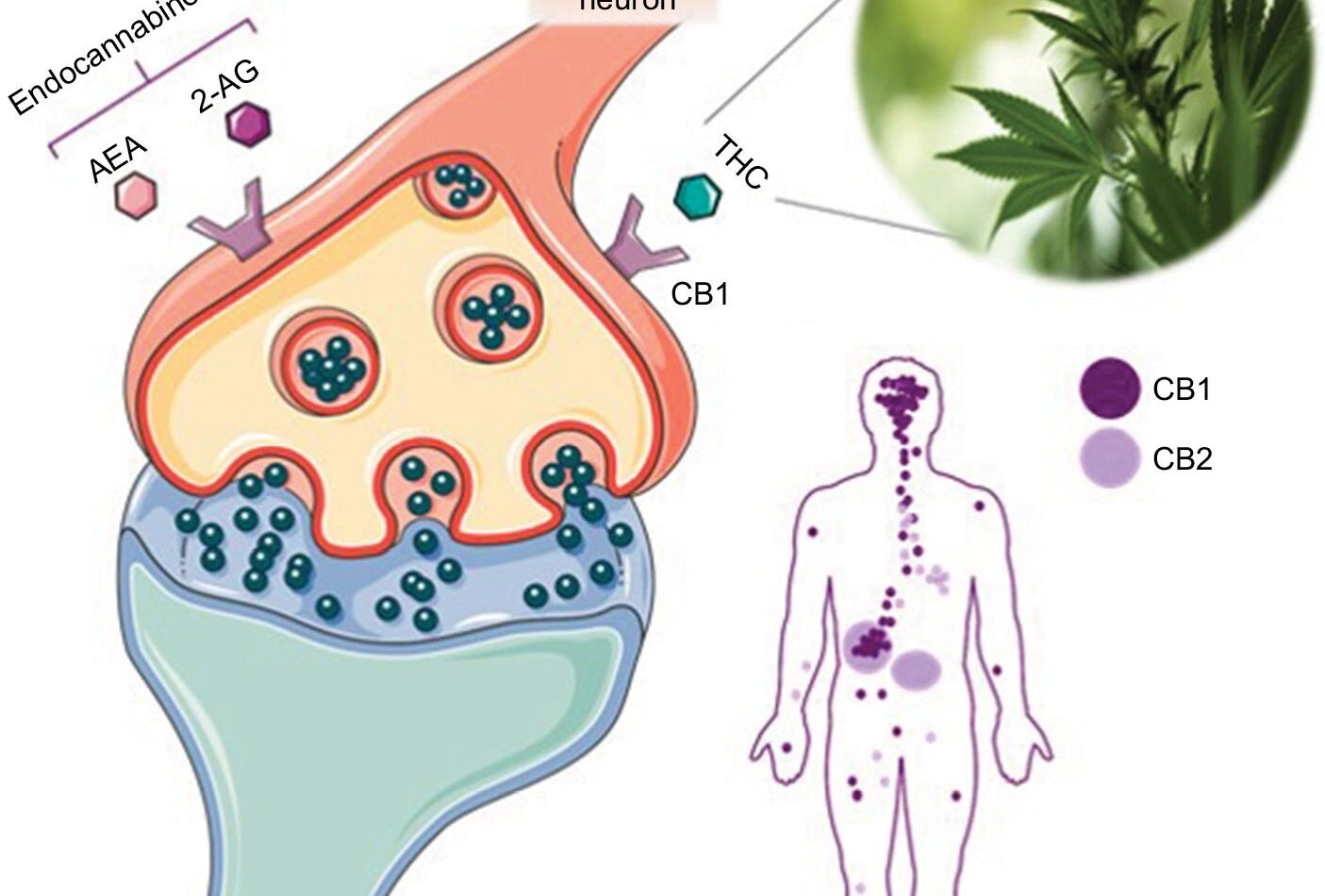
In the central nervous system (CNS), CB1 is by far the predominant form, although it also exists outside the CNS; CB2 is primarily found outside the CNS, and is associated with the immune system. Both receptor subtypes are 7-transmembrane domain macromolecules of the “G-protein-coupled” class. Unexpectedly, CB1 turned out to be one of the most abundant G-protein-coupled receptors in the brain. It was immediately obvious that CB1 and CB2 must partner with an endogenous ligand, a natural agent for which they would normally act as the proper receptors. They did not evolve to react with rarely ingested, plant-derived chemicals. Indeed, Mechoulam’s group isolated an arachidonic acid derivative (N-arachidonoylethanolamide, “anandamide”) that activated CB1,5 and a second endogenous CB1 ligand two-arachidonolyl glycerol (2-AG) was later discovered.6,7
These endocannabinoids are the major physiological activators of CB1 and CB2, yet they are not standard neurotransmitters. For one thing, like THC, they are lipids, and brain cells, mainly neurons, are surrounded by an aqueous solution, an inhospitable environment for an intercellular lipid messenger. More surprisingly, endocannabinoids go against the flow of typical chemical synaptic signaling. A neuron that releases a chemical neurotransmitter (say, GABA or glutamate) is designated as “pre-synaptic”; the target neuron that expresses receptors for that neurotransmitter is “postsynaptic.” Endocannabinoids, however, are synthesized and released from postsynaptic cells, and travel backward (in the “retrograde” direction) across the synapse, where they encounter CB1s located on adjacent nerve terminals.8,9 Physiologically, CB1Rs act as communications traffic cops. Precisely positioned in synaptic regions,10 they inhibit the release of many excitatory and inhibitory neurotransmitters. Thus, by releasing endocannabinoids, postsynaptic target cells can influence their own incoming synaptic signals.
CB1 is densely located in the neocortex, hippocampus, basal ganglia, amygdala, striatum, cerebellum, and hypothalamus. These major brain regions mediate a wide variety of high-order behavioral functions, including learning and memory, executive function decision making, sensory and motor responsiveness, and emotional reactions, as well as feeding and other homeostatic processes. Within neuronal circuits, suppression of excitatory transmitter release tends to dampen excitation, while suppression of inhibitory transmitter release favors neuronal network excitation. Given the enormous complexity of the brain, the endocannabinoid system could affect behavior in an almost limitless number of ways: Simple generalizations of what will happen when CB1 receptors are globally turned on or off are not feasible. The challenge for developers of cannabinoid-based medicines is to find beneficial ways to exploit this powerful yet convoluted feedback system.
Thank you for visiting the GCRC Website,
–Mike Robinson, Founder – Global Cannabinoid Research Center / GCRC Publications
This article is educational commentary from GCRC. It is not a report of study findings and is not medical advice. Speak with a qualified healthcare professional about your own health.