Immunoregulatory Role of Cannabinoids during Infectious Disease
During a time of uncertainty we felt it was important to share research that highlights the abilities of multiple cannabinoids in various forms that have been proven to fight intense infectious...
 Mike Robinson
8 min read
During a time of uncertainty we felt it was important to share research that highlights the abilities of multiple cannabinoids in various forms that have been proven to fight intense infectious diseases. It's beyond amazing to see how certain cannabis extracts formulated in specific ways can exert microbicidal activity on bacteria's. Staph and Strep are well known but this research shows the immense abilities to fight Sepsis, Legionnaire's disease, Listeriosis which causes meningoencephalitis and more, Fusobacterium nucleatum which causes pulmonary and cerebral abscesses, Streptococcus pneumoniae which causes meningitis, and the list goes on. While we have a serious situation knocking at our door today with the spread of a virus that seems very uncontrollable – we also have vast information at our fingertips to fight it. It's up to us to take the information and put that knowledge into action.
Immunoregulatory Role of Cannabinoids during Infectious Disease:
Hernández-Cervantes R.a · Méndez-Díaz M.b · Prospéro-García Ó.b · Morales-Montor J.a
Author affiliations
Keywords: EndocannabinoidsInfectionsVirusBacteriaParasites
Neuroimmunomodulation 2017;24:183–199https://doi.org/10.1159/000481824
Abstract
Although the endocannabinoid system (ECS) is involved in the regulation of several physiological processes, including sleep and the immune response, its role during infections has not been fully studied. It is well known that the use of this drug increases susceptibility to infections because of the impact on the modulation of the immune system. Concerning the medicinal or recreational use of marijuana, its influence on the course of an infection, whether this has been caused by bacteria, viruses, parasites, and to a lesser degree, fungi, has been reported. Furthermore, there is evidence suggesting the involvement of the ECS in the control and elimination of infectious agents such as bacteria, viruses, and some protozoa; in the case of fungi, few studies are available so far. The purpose of this review is to present the existing studies related to infections and the ECS, the microbicidal effects of compounds isolated from Cannabis sativa, and the association between marijuana use and the development of rare pathologies in specific diseases.
© 2017 S. Karger AG, Basel and reprinted with permission
Immune System
The immune system has the important function of defending the host from foreign agents or pathogens, and, depending on the nature of these, it makes use of innate and/or adaptive immunity mechanisms to eliminate them. In both cases, proteins and specialized cells are involved in eliminating pathogens. Briefly, innate immunity involves natural barriers as well as the complement system, e.g., the skin and mucous membranes contain phagocytic cells able to recognize pathogen-associated molecular patterns (PAMPs) through pattern recognition receptors (PRRs). These mechanisms isolate the infectious agent by an inflammation process, thereby preventing replication, spreading, and damage. If the infectious agent evades the innate immunity response, the components of adaptive immunity are initiated. This response is pathogen-specific and involves T and B lymphocytes. T lymphocytes recognize antigens via T cell receptors and resulting in the activation of different pathways, depending on the nature of the lymphocyte. CD4+ T helper cells recognize the antigen through the major histocompatibility complex class II (MHC II) whereas CD8+ T cytotoxic cells achieve this through the MHC I. B lymphocytes can also recognize antigens, and are known to participate in antibody-mediated immunity. An effective immune response also involves other cells such as monocytes, neutrophils, eosinophils, macrophages, dendritic cells, natural killer (NK) cells, and Tγδ cells, among others. The participation of these cells depends on the site of the infection, the infectious agent, and other factors to be able to identify, isolate, and eliminate pathogens. Thus, the immune system puts in place a complex mechanism to fulfill its function, including responding to hormones, neurotransmitters, and proteins, and specific lipids, such as endocannabinoids (eCBs). As some of these cells bear cannabinoid membrane receptors, i.e., cannabinoid receptor 1 (CB1) and CB2 [1], it may be that the activation of the endocannabinoid system (ECS) plays a decisive role in preventing the development of a disease.
The Endocannabinoid System
The ECS is composed of eCBs and enzymes (for the synthesis and breakdown of eCBs), as well as the cannabinoid receptors, CB1 and CB2, which are widely distributed throughout the body. Cannabinoid receptors are activated by different ligands that are either endogenous, such as eCBs, or exogenous, such as marijuana derivatives and synthetic compounds.
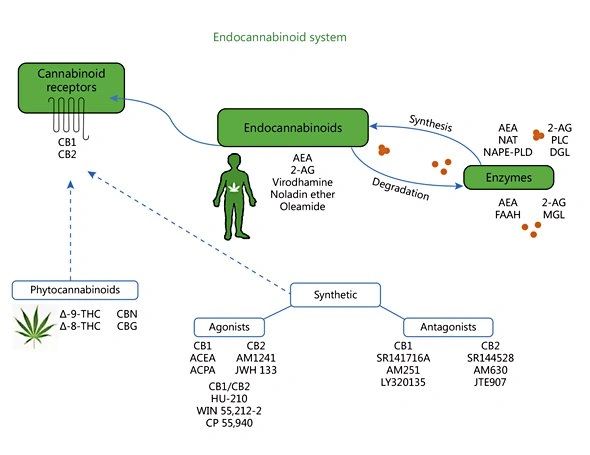
The term cannabinoid includes compounds of different origin: endogenous cannabinoids (i.e., the eCBs), cannabinoids from vegetable origin or phytocannannabinoids, and cannabinoids from synthetic origin, either agonists or antagonists to the cannabinoid receptors (Fig. 1). (shown as cover photo)
Based on their chemical structure, cannabinoids are divided into 4 groups: classical, nonclassical, aminoalkylindoles, and eicosanoids. Classical cannabinoids are dibenzopyran derivatives, such as 9-tetrahydrocannabinol (9-THC) and HU-210; nonclassical cannabinoids contains bicyclic and tricyclic analogs of 9-THC that lack a pyran ring like CP 55,940; aminoalkylindoles have structures that differ markedly from those of both classical and nonclassical cannabinoids and are well represented by WIN 55,212-2, a derivative of pravadoline; and eicosanoids have structures quite unlike those previously mentioned, with N-arachidonoylethanolamine (anandamide [AEA]) and 2-arachidonoylglycerol (2-AG) being the main ones [2].
Approximately 60 phytocannabinoids are synthesized by Cannabis sativa [3,4]; of these, Δ-9-THC (THC) is the main psychoactive compound [5]. Other cannabinoids found in cannabis are Δ-8-THC, cannabidiol (CBD), cannabinol (CBN), cannabigerol (CBG), and cannabichromene (CBC) [6], among others. Furthermore, other organisms also produce their own cannabinoids, i.e., eCBs, derived from arachidonic acid, such as AEA and 2-AG, O-arachidonyl ethanolamine (virodhamine), 2-arachidonylglycerylether (noladin ether), N-arachidonoyl dopamine (NADA), and oleamide. There are cannabinoid-related molecules called N-acylethanolamides, such as palmitoylethanolamide (PEA) and oleoylethanolamide (OEA), that do not activate the CB1 receptor but instead interact with the peroxisome proliferator-activated receptor (PPAR)α, mediating anti-inflammatory processes [7,8].
There are a large number of cannabinoids of synthetic origin, differing in their affinity to one or both cannabinoid receptors; in addition, there are also agonists or antagonists which have been useful in the experimental study of the ECS.
eCBs can be defined as endogenous lipids, derivatives of amides, esters, and ethers, and comprise long-chain polyunsaturated fatty acids, mainly arachidonic acid. eCBs are located in lipid membranes, synthesized on demand in a Ca+2-dependent fashion in response to either physiological or pathological stimuli [9] and, in the case of AEA, accumulation and breakdown in liposomes [10]. AEA and 2-AG are the most studied eCBs and, despite being arachidonic acid derivatives, they can be synthesized by several pathways; however, the enzymes required are not the same in all instances. The enzymes required for AEA synthesis are N-acyltransferase (NAT) and N-acyl phosphatidylethanolamine phospholipase D (NAPE-PLD). For 2-AG synthesis, the enzymes phospholipase C (PLC) and diacylglycerol lipase (DGL) are required, among others. Breakdown enzymes also differ between AEA and 2-AG; fatty acid amide hydrolase (FAAH) is responsible for AEA hydrolysis whereas monoacylglycerol lipase (MGL) is required in the case of 2-AG [9] (Fig. 1; [11]).
In addition to CB1 and CB2, the existence of a third cannabinoid receptor (CB3) has been suggested [12], and there are also 2 orphan G protein-coupled receptors (GPCRs) which overlap with CB1 and CB2, namely, GPR18 and GPR55 [13]. CB1 and CB2 are associated with the G proteins of the Gi/o family (Gi1-3 and Go1 and 2) via the intracellular loops of the protein. Both cannabinoid receptors inhibit adenylyl cyclase via Gi and stimulate MAPK activity. By inhibiting adenylate cyclase, the reduction of the second messenger cAMP leads to the opening of rectifying potassium channels. CB1 also mediates the inhibition of N-type and P/Q-type calcium currents [14,15].
The cannabinoid receptors are widely distributed; CB1 is expressed mainly in the central nervous system (CNS), particularly in the cerebral cortex, olfactory bulb, cerebellum, and spinal cord [16]. It can also be located in peripheral tissues such as the adrenal glands, thymus, tonsils, lungs, heart, bone marrow, prostate, uterus, ovaries, and testes [17]. Although CB1 mRNA levels represent only 1-10% of the CB2 content in immune tissues, they are expressed (from the highest to the lowest expression level) in B lymphocytes, NK cells, polymorphonuclear neutrophils, CD8 T cells, and CD4 T cells [1]. CB2, on the other hand, is also expressed in the CNS but is most highly expressed in immune tissues such as the spleen and thymus [1,18] as well as in blood cell subpopulations such as CD4 and CD8 lymphocytes, neutrophils, monocytes, NK cells, and B lymphocytes [1].
CB1 and CB2 and Physiological Regulation
The activation of cannabinoid receptors is involved in biological processes such as appetite, or in antiemetic and analgesic effects. Moreover, the therapeutic use of cannabinoids has proved effective in the treatment of neuropathic pain [19,20,21], epilepsy, multiple sclerosis (MS), feeding disorders, and glaucoma [15,22,23]. However, since cannabinoid receptors are present on immune cells, they can modulate the function of the immune system, potentially inducing immunosuppression [24,25]. As an example, the eCBs AEA and 2-AG can modulate inflammation, although not always in association with cannabinoid receptor binding, due to an arachidonic acid molecule within the structure, which is a precursor of bioactive or anti-inflammatory lipids; moreover, they can be metabolized by biosynthetic eicosanoid molecules producing additional lipids [11].
Synthetic cannabinoids are widely used in biomedical research, in the form of compounds with preferential activity over CB1, e.g., arachidonyl-2-chloroethanolamide (ACEA) and arachidonyl-cyclopropylamide (ACPA). CB2 is activated by compounds such AM1241, JWH-133, HU-910, and HU-308 [26]; in addition, there are compounds without special selectivity for either cannabinoid receptor, such as HU-210, CP 55,940, and R-(+)-WIN 55,212-2. On the other hand, there are CB1 antagonists such as SR141716A and AM251; and CB2 antagonists such as SR144528 and AM630 [14,26] (Fig. 1). Their use in research has been crucial in unraveling the role of ECS activation in some diseases caused by infectious agents.
The Role of the ECS in Bacterial Infections
Phylogenetic analyses have reported the presence of cannabinoid receptors in phylum Chordata organisms, such as Ciona intestinalis[27] or Branchiostoma floridae [28]. Although there are no available reports regarding the presence of cannabinoid receptors in organisms belonging to other phyla like Proteobacteria, Vira, Nematoda, or Deuteromycota, this is very likely because the exogenous activation of the ECS plays an important role in the development of bacterial infections, both in vitro and in vivo (Table 1).
Please read the balance of the research article on it's original publication, please do not reprint without proper accreditation to the authors and copyrighted publication:
https://www.karger.com/Article/FullText/481824
Thank you,
Mike Robinson, Founder, Global Cannabinoid Research Center
This article is educational commentary from GCRC. It is not a report of study findings and is not medical advice. Speak with a qualified healthcare professional about your own health.