
New Research: ECS Reverses Diet-induced Steatosis via CB1
It's important to keep up to date with hot off the press cannabinoid medicine or endocannabinoid system research - and this just became available. Non-alcoholic fatty liver disease (NAFLD), which...
 Mike Robinson
4 min read

It's important to keep up to date with hot off the press cannabinoid medicine or endocannabinoid system research – and this just became available. Non-alcoholic fatty liver disease (NAFLD), which includes steatosis and its progression to non-alcoholic steatohepatitis, is a liver disorder of increasing clinical significance. But what does that mean? Our diets consist of so many fatty, sugary, and salty foods that it puts an undue amount of burden upon our internal organs – namely the liver in metabolizing them. Alcohol is often blamed for liver diseases when indeed it's what's in our kitchen, at the convenience store – and especially at a fast food establishment – that will get us. It's well known in the scientific community that chronic changes induced by the prolonged consumption of a high-fat diet alone culminate in the development of primary liver dysplasia's.
Let's review the Research Article:
Reversal of Diet-induced Hepatic Steatosis by Peripheral CB1 Receptor Blockade in Mice is p53/miRNA-22/SIRT1/PPARα Dependent:
Obesity and Metabolism Laboratory, Institute for Drug Research, School of Pharmacy, Faculty of Medicine, The Hebrew University of Jerusalem, Jerusalem.
DOI: https://doi.org/10.1016/j.molmet.2020.101087 26 September 2020.
Abstract
Objective
The endocannabinoid (eCB) system is increasingly recognized as being of crucial importance in obesity-related hepatic steatosis. eCBs, via activation of the hepatic cannabinoid-1 receptor (CB1R), modulate lipogenesis and fatty acid oxidation. However, the underlying molecular mechanisms are largely unknown.
Methods
We combined unbiased bioinformatics techniques, mouse genetic manipulations, multiple pharmacological, molecular and cellular biology approaches, and genomic sequencing to systematically decipher the role of hepatic CB1R in modulating fat utilization in the liver, and explored the downstream molecular mechanisms.
Results
Using an unbiased normalized phylogenetic profiling analysis, we found that CB1R evolutionarily coevolves with peroxisome proliferator-activated receptor-alpha (PPARα), a key regulator of hepatic lipid metabolism. In diet-induced obese (DIO) mice, peripheral CB1R blockade (using AM6545) induced the reversal of hepatic steatosis and improved liver injury in WT, but not in PPARα-/- mice. The antisteatotic effect, mediated by AM6545 in WT DIO mice, was accompanied by increased hepatic expression and activity of PPARα as well as elevated hepatic levels of the PPARα-activating eCB-like molecules, oleoylethanolamine and palmitoylethanolamide. Moreover, AM6545 was unable to rescue hepatic steatosis in DIO mice lacking liver sirtuin 1 (SIRT1), an upstream regulator of PPARα. Both of these signaling molecules were modulated by CB1R, as measured in hepatocytes exposed to lipotoxic conditions or treated with CB1R agonists in the absence/presence of AM6545. Furthermore, using microRNA transcriptomic profiling, we found that CB1R regulated the hepatic expression, acetylation, and transcriptional activity of p53, resulting in the enhanced expression of miR-22, which was found to specifically target SIRT1 and PPARα.
Conclusions
We provide a strong evidence for a functional role of the p53/miR-22/SIRT1/PPARα signaling pathway in potentially mediating the antisteatotic effect of peripherally restricted CB1R blockade.
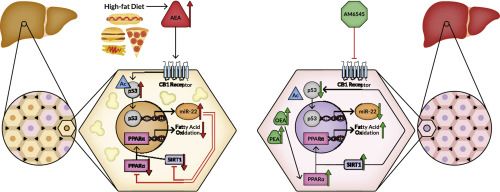
Graphical abstract
Graphical Abstract; The elucidated molecular signaling pathway by which hepatic CB1R regulate hepatic lipid homeostasis. Activation of hepatic CB1R increases p53 expression, acetylation, nuclear localization, and transcriptional activity that together promote the expression of miR-22, which in turn, reduces the expression and activity of PPARα and SIRT1. These events lead to reduced fatty acid oxidation and to fat accumulation in the liver (left). Treatment with AM6545, a peripherally restricted CB1R antagonist, disrupts this signaling pathway and ameliorates hepatic steatosis, also by increasing hepatic OEA and PEA, which may activate PPARα directly, resulting in the enhanced efficacy of AM6545 in ameliorating hepatic steatosis (right).
Click here to View Entire Abstract
————————————–
The Endocannabinoid system is just as important as all other bodily systems – without it functioning properly our health will fail and life can come to an end in various ways. It's imperative we continue researching, learning, and educating the public at large while physicians, clinicians, healthcare workers and others in the people industry catch up to us. Without education and without ongoing research the answers to so many health related questions will continue to be held at bay.
Thank you to Hebrew International for the ongoing work,
This article is educational commentary from GCRC. It is not a report of study findings and is not medical advice. Speak with a qualified healthcare professional about your own health.