
CBD or THC: Which One Helps People Quit Drinking or Consume Less?
The boom of Recreational marijuana legalization has led to increased use with alcohol - with many are unaware how some cannabinoids can enhance the effect of overall inebriation. Often it's very high...
 admin
5 min read
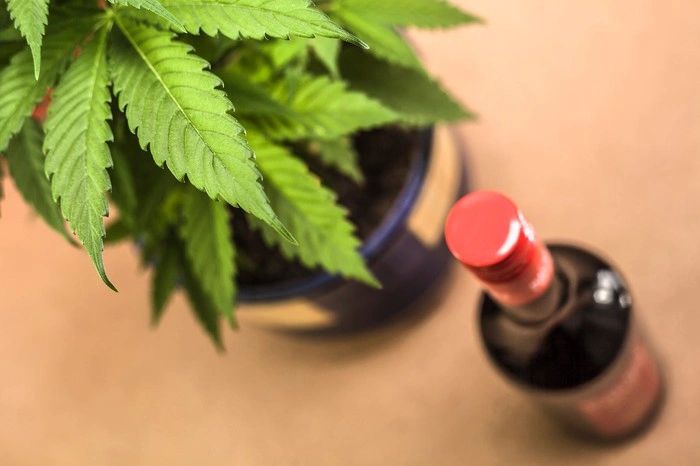
The boom of Recreational marijuana legalization has led to increased use with alcohol – with many are unaware how some cannabinoids can enhance the effect of overall inebriation. Often it's very high THC cannabis used in this scenario so mixing the two would seem enjoyable – but many are finding that it isn't that simple.
Alcohol itself is a very psychoactive substance and mixing the two can cause severe symptoms that are often unwanted and much worse as this combo is known to kill much more than the individual using it.
According to one of the few notable articles on the subject, which also mentioned that THC and alcohol is the most common mixture detected in the blood alcohol levels in car accidents, alcohol increased the potency of marijuana. [1]
In a small study of 19 adults, the non-placebo groups were provided with THC via inhalation and a low dose of alcohol. It was discovered that the levels of THC measured in the blood of the alcohol group were much higher than in the control group. The authors felt that this may “possibly explain increased performance impairment observed from cannabis-alcohol combinations.” [2]
Together with increased levels of impairment, combining THC with alcohol may have several other side effects. Those reported include:
- Nausea
- Vomiting
- Dizziness
Both substances increase impairment, and therefore it can become difficult to make accurate judgments on how much of either is safe to consume. Theoretically, at least, it can even lead to toxic alcohol poisoning and which does in more extreme cases cause severe brain or organ injury – or even death.
What about CBD?
The consumption of CBD and alcohol doesn’t seem to trigger the same unwanted effects. The reasons for this is that the cannabinoid causes metabolism to increase and is not psychoactive. One study dating all the way back to 1979 showed that CBD and alcohol, when paired together "resulted in significantly lower blood alcohol levels compared to alcohol given alone.” [3]
In a 2015 Canadian research study entitled "Cannabidiol as an Intervention for Addictive Behaviors: A Systematic Review of the Evidence" the authors concluded:
"CBD may have therapeutic properties on opioid, cocaine, and psychostimulant addiction, and some preliminary data suggest that it may be beneficial in cannabis and tobacco addiction in humans. Further studies are clearly necessary to fully evaluate the potential of CBD as an intervention for addictive disorders."
They also found that there “was no difference in feelings of being ‘drunk, drugged, or bad’ in alcohol alone, and alcohol plus CBD groups,” in the one study they could locate. [4]
What about Alcoholism?
A quick review of this data along with even more research brings any reader to a quick conclusion that THC could lead to increased drinking while CBD does not. While CBD allows the body to metabolize the substance from the system, THC causes that process to slow down while also increasing levels of inebriation.
CBD, on the other hand, has been featured in various studies on drug dependence as being an aide that consumers can depend on. Online accounts of people who have maintained control over addictions or beat them through the use of CBD are countless – but they're also flooding the internet channels about THC, CBG, and more. The difference is in control of urges or impulses as that's what causes all of us with addictive behaviors to drink or use a substance again.
A very promising preliminary study showed that CBD can help prevent relapse in alcohol-dependent mice. This effect lasted up to five months after treatment termination, even when CBD plasma and brain levels were zero after only three days. [5]
GCRC/Mike Robinson's Conclusion:
Research in this area is scant to say the least and the reason why is beyond obvious. There's a lot of money in the Alcohol industry and if something can lead to less use it's probably not going to get the funding it needs to prove it easily. But, we know with no doubt that CBD increases metabolism. But what's not covered in this article is WHEN to use the Cannabinoid.
Often the THC user is smoking the cannabis or using concentrates while drinking so it's very easy to see the interaction. The CBD user that takes a daily dose will have the results that have been indicated in research – or something close to that. But, the individual that has too much to drink and then takes CBD to 'sober up' will find that it doesn't work that way.
If a person uses the cannabinoid in that manner they will have a reduced blood alcohol level – but only after it rapidly increases first due to the introduction of a substance that rapidly increases metabolism. With every great thing there's a downside – more research is definitely necessary. For now we can state that CBD reduces cravings in addiction as well as increases metabolism – so it would be beneficial for both the individual quitting alcohol as well as not be anywhere near as problematic as THC combined with Alcohol.
We must be responsible in our quest for legitimacy of the banished cannabis plant – there's no questioning that a combo of psychoactive substances that causes lowered metabolism of Alcohol and increased car wrecks isn't a great idea.
As a matter of fact it's such a horrid plan that as a public speaker the founder of the GCRC will not speak at and will rarely attend Cannabis 'mixer' events serving alcohol. We do not believe the combination legitimizes any type of medicine.
Preliminary, with all certainty, it appears that THC would not be best cannabinoid to introduce to an individual while attempting to reduce the amount they drink – but it could be extremely helpful once they completely quick.
For the recovering alcoholic THC tends to work wonders in conjunction with CBD and other hemp extracts from patient accounts and my own experience. There's a vast difference between what works as a 'replacement therapy' and what will happen when substances are combined.
–Mike Robinson, Founder – Global Cannabinoid Research Center
Contact Mike today about opportunities with GCRC
Read The (HUG) Hemp Users Guide
Contact Mike today about opportunities with GCRC
References:
[2] http://clinchem.aaccjnls.org/content/early/2015/05/05/clinchem.2015.238287
This article is educational commentary from GCRC. It is not a report of study findings and is not medical advice. Speak with a qualified healthcare professional about your own health.