
Cannabis CBG Genetics: How Scientists Are Unlocking the Plant’s Ability to Produce More CBGA
 Mike Robinson
What if the secret to producing more CBGA isn’t making geneticists work harder, but being smarter about why certain plants naturally stop converting it into other cannabinoids?
That’s the question behind new genetic research published November 19, 2026, by scientists at Cornell University and collaborating researchers. Their study, “Complementation of independent mutations resulting in CBG-dominant Cannabis sativa L.,” examines how different genetic mutations influence cannabinoid production and how those discoveries could help breeders develop plants with more predictable cannabinoid profiles [1].
For anyone interested in Cannabis CBG, this research provides something particularly valuable. Rather than looking at what cannabinoids do after entering the human body, researchers went directly to the plant’s genetic machinery to understand why certain varieties accumulate CBGA while others convert most of it into THCA or CBDA.
The findings also reinforce something I’ve emphasized throughout cannabinoid research. CBGA and CBG are related, but they’re different compounds, and understanding where one originates is essential to understanding the other.
CBGA Is Where Major Cannabinoid Production Begins
Cannabigerolic acid, commonly called CBGA, serves as a central precursor in the plant’s cannabinoid biosynthetic pathway. It’s produced through a series of biochemical reactions and subsequently becomes the starting material for several major cannabinoids.
Specialized enzymes called cannabinoid synthases determine much of what happens next. THCA synthase converts CBGA into THCA, while CBDA synthase converts it into CBDA. Another enzyme, CBCA synthase, can convert CBGA into CBCA.
When these acidic cannabinoids undergo decarboxylation, typically through heating or prolonged environmental exposure, they form their corresponding neutral compounds, including THC, CBD, CBC, and CBG.
That distinction matters because living cannabis plants generally accumulate cannabinoids primarily in their acidic forms.
A plant described as CBG-dominant is usually accumulating CBGA, with some of that material potentially converting into CBG during drying, processing, or heating. Understanding this pathway changes the way we approach cannabinoid production.
Instead of assuming that producing more CBG requires increasing the activity of a special CBG-producing enzyme, researchers can investigate the enzymes responsible for converting CBGA into other cannabinoids.
If those downstream pathways aren’t functioning normally, CBGA can accumulate [1,2].
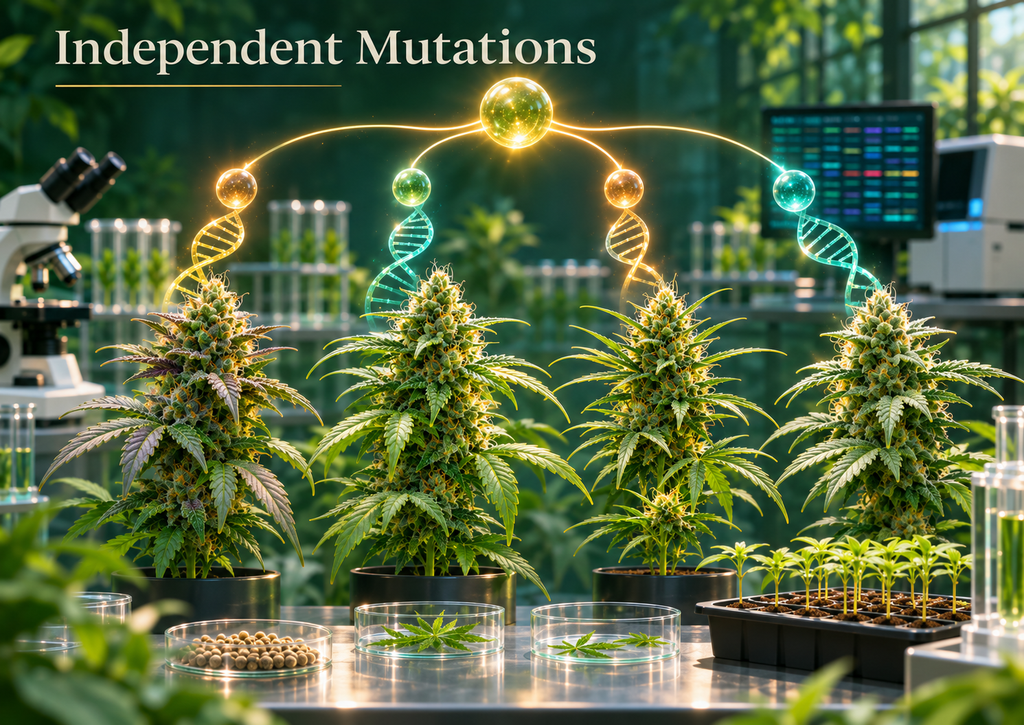
Four Different Mutations Can Lead to CBG-Dominant Plants
The Cornell researchers investigated four independently identified genetic mutations associated with CBG-dominant cannabinoid profiles.
These mutations affect the genetic machinery responsible for downstream cannabinoid production. When plants inherit particular nonfunctional variants from both parents, they can accumulate CBGA rather than efficiently converting it into other major cannabinoids.
One especially interesting finding involved a structural genetic variant that completely deletes the CBDA synthase gene. This goes beyond a minor change in a DNA sequence. In this particular genetic arrangement, a gene responsible for producing CBDA synthase is missing entirely.
Other mutations can interfere with cannabinoid production through different genetic changes, including alterations that leave a synthase gene present but prevent it from functioning normally.
Earlier research demonstrated that an apparently nonfunctional THCA synthase variant was associated with CBGA dominance and could behave as a recessive inherited trait [2]. Together, these findings help explain why different CBG-dominant plants can produce similar cannabinoid profiles without necessarily having identical genetic backgrounds.
That’s important for breeding because two plants that look chemically similar may respond differently when crossed with other varieties.

Scientists Identified 39 Distinct Genetic Haplogroups
One of the strongest aspects of this research involved examining the larger genetic neighborhood surrounding cannabinoid synthase genes.
Researchers compared the regions associated with their four mutations against corresponding DNA regions from more than 150 publicly available cannabis genome assemblies. That comparison identified 39 structurally distinct haplogroups [1].
A haplogroup, in this context, represents a group of related genetic arrangements that share certain inherited characteristics.
Finding 39 structurally different groups demonstrates just how complicated this region of the cannabis genome can be.
Some genetic arrangements contain different combinations of synthase-related sequences, while others include structural changes such as gene deletions.
These variations help determine which enzymes a plant can produce and which cannabinoids may accumulate. The broader implication is that a single genetic marker can’t always explain cannabinoid production.
The surrounding DNA matters, and researchers need to understand how entire genetic arrangements influence the plant’s chemistry. For breeders, this means cannabinoid genetics is becoming much more precise than simply selecting plants with attractive laboratory reports.
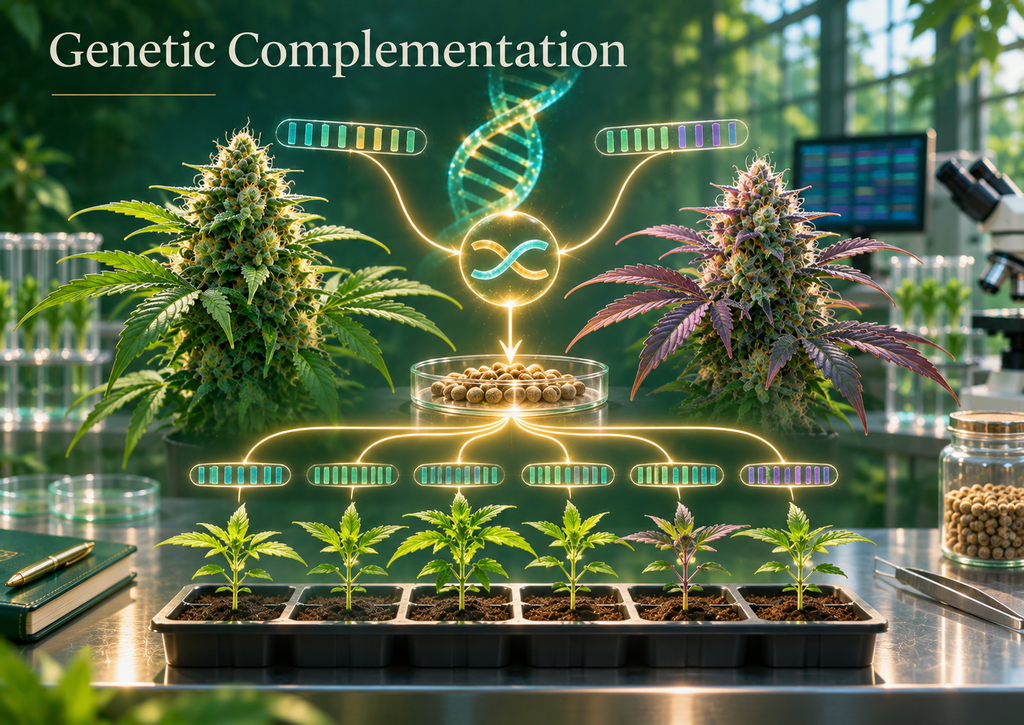
Why Crossing Two CBG-Dominant Plants Requires Genetic Understanding
The word “complementation” in this study’s title refers to an important principle in genetics. When researchers cross plants carrying different mutations, they can investigate whether inherited genetic components compensate for one another and change the resulting characteristics.
In straightforward terms, a plant may carry a mutation that prevents a particular enzyme from functioning. Another plant may carry a different mutation. Depending on the genes and variants involved, their offspring can exhibit different biochemical characteristics from either parent.
In some genetic systems, combining different mutations restores a function that was missing from both parents. In others, the mutations fail to complement one another, and the original characteristic remains.
The researchers generated and characterized more than 30 experimental plant populations combining mutated and functional cannabinoid synthase haplogroups [1].
Their objective was to understand better how these genetic combinations influence cannabinoid profiles. This is particularly relevant when developing stable CBG-dominant cultivars because crossing two plants with desirable cannabinoid characteristics doesn’t automatically guarantee that every offspring will retain those characteristics.
Breeders need to know which genetic variants they’re combining, how those variants are inherited, and whether the resulting plants continue producing the intended cannabinoid profile. That knowledge becomes especially valuable when maintaining low levels of THC while concentrating production around CBGA.

Molecular Markers Could Make CBG Breeding More Predictable
The researchers also developed high-throughput molecular markers designed to identify specific mutated cannabinoid synthase haplogroups [1]. Molecular markers allow plant breeders to examine inherited DNA characteristics without relying entirely on observing mature plants or waiting for flowers to develop.
This can make breeding programs more efficient by helping researchers identify promising genetic combinations earlier in development. For example, a breeder working toward a stable CBGA-dominant cultivar could use genetic screening to help identify plants carrying desired variants before investing substantial resources into growing them to maturity.
Earlier research from Cornell demonstrated the usefulness of molecular markers for identifying cannabinoid chemotypes and supporting more efficient cannabis breeding [3]. The newer study expands that foundation by examining additional mutations and the broader structural diversity surrounding them.
Still, molecular markers aren’t replacements for chemical testing. Genetic predictions must be confirmed by analyzing actual cannabinoid concentrations in the plant. Environmental conditions, developmental stage, cultivation practices, and other inherited characteristics can influence the final chemical profile.
A plant carrying a desired genetic marker isn’t automatically guaranteed to produce a specific percentage of CBGA or remain within applicable THC limits.
The Difference Between CBGA Production and CBG Content
There’s another distinction worth discussing because it’s frequently overlooked in conversations about CBG cultivation. When growers describe plants as high in CBG, their laboratory results may reflect a calculation that includes both measured CBG and CBGA, adjusted for the molecular weight lost during decarboxylation.
That doesn’t mean all the cannabinoid material existed as neutral CBG inside the living plant. CBGA is the acidic precursor, and it has its own biological properties that shouldn’t automatically be treated as identical to those of CBG.
The distinction becomes particularly important when developing cannabinoid products intended to preserve acidic cannabinoids rather than convert them through heating. From my perspective, research that improves our understanding of CBGA accumulation has implications beyond simply increasing CBG production.
It could help breeders develop plant material specifically suited for studying CBGA while also improving consistency in products containing CBG. Both compounds deserve independent evaluation, particularly when researchers investigate their different pharmacological properties.
What This Research Means for the Future of Cannabinoid Production
This study offers several practical implications for plant science and cannabinoid development. First, it shows that CBG-dominant plants can arise through multiple genetic routes rather than a single universal mutation.
Second, it provides a more detailed picture of the structurally complex genomic region that controls key steps in cannabinoid biosynthesis.
Third, the molecular markers developed by the researchers may provide breeders with better tools for identifying desired genetic variants and selecting parent plants.
These improvements could support more consistent cultivation programs, especially where cannabinoid composition and regulatory compliance are important. However, this wasn’t a human clinical study, and it doesn’t demonstrate that genetically selected CBGA-dominant plants provide greater therapeutic benefits.
The research also doesn’t establish that every desirable cannabinoid ratio can be achieved simply by selecting a particular genetic marker.
Its contribution is to plant genetics, cannabinoid biosynthesis, and the scientific understanding needed for more reliable breeding.
GCRC Perspective: Better Genetics Creates Better Research Opportunities
I’ve spent years emphasizing that cannabinoid research needs to move beyond treating every compound from the plant as interchangeable.
CBGA is particularly important because it sits at the center of the biosynthetic pathway that produces several of the plant’s best-known cannabinoids.
Understanding how genetic mutations influence that pathway opens opportunities to study specific cannabinoids more consistently and with fewer unwanted variations in plant chemistry.
For researchers investigating CBGA and CBG independently, dependable plant genetics could make an enormous difference. When the starting material becomes more consistent, it becomes easier to design experiments that isolate the biological activity of individual compounds.
There’s also a broader lesson here about the importance of preserving genetic diversity. Different mutations may produce similar chemical results, but those genetic differences can become valuable when researchers investigate stability, inheritance, and future breeding opportunities.
What stands out to me about this study isn’t simply the possibility of producing more CBG. It’s the progress toward understanding why a plant produces the cannabinoids it does in the first place.
We’ve spent decades studying cannabinoids after they’re harvested. Research like this helps us understand the genetic decisions taking place long before harvest, and that knowledge could become an important foundation for future cannabinoid research, cultivation, and formulation.
Understanding how to produce CBGA more reliably doesn’t prove what it can accomplish medically, but it gives scientists a stronger foundation for finding out.
Global Cannabinoid Research Center
References
[1] Stack, G. M., et al. (2026). “Complementation of independent mutations resulting in CBG-dominant Cannabis sativa L.” Published November 19, 2026. https://doi.org/10.1093/plphys/kiag870
[2] Garfinkel, A. R., et al. (2021). “SNP in Potentially Defunct Tetrahydrocannabinolic Acid Synthase Is a Marker for Cannabigerolic Acid Dominance in Cannabis sativa L.” https://doi.org/10.3390/genes12020228
[3] Toth, J. A., et al. (2020). “Development and validation of genetic markers for sex and cannabinoid chemotype in Cannabis sativa L.” https://doi.org/10.1111/gcbb.12667
This article is educational commentary from GCRC. It is not a report of study findings and is not medical advice. Speak with a qualified healthcare professional about your own health.